

Money Usage in the Dominican Republic in 2026 – Cash, Cards, ATMs & Tipping Guide
When planning a trip to the Caribbean, figuring out how to handle money in the Dominican Republic is just as important as packing your swimsuit. The country’s financial landscape in 2026 is a complex mix of modern digital technology and a traditional economy deeply rooted in cash transactions. A successful and safe trip requires a clear understanding of how the local financial system works.
Guideline to handling money, cash, cards, and ATMs in the DR
Choosing the wrong payment methods, being unaware of currency conversion rules, or carelessly using ATMs can lead to significant financial losses – sometimes reaching up to 15-20% of a travel budget due to hidden fees and poor exchange rates. Properly balancing your funds across cash, bank cards, and digital wallets not only saves money but also ensures personal safety.
Customs Rules and the Mandatory E-Ticket
for Pre-Trip Preparation
Financial security begins long before you land at the airport. Crossing the border into the Dominican Republic involves a series of strict requirements; failing to comply can result in fines or delays at customs.
How to avoid E-Ticket scams
To modernize immigration control, the government has completely phased out paper immigration and customs declaration forms. In 2026, filling out the electronic E-Ticket form is strictly mandatory for absolutely all commercial flight passengers. This document combines health data, the customs declaration, and immigration information.
Traveler experiences confirm that without a generated E-Ticket QR code, airlines have every right to deny boarding, and border control will not stamp your passport.
Step-by-step e-ticket process
Completing the form requires attention to detail and having all necessary documents on hand. We recommend following this process:
- Platform selection. You must use only the official government portal.
- Language settings. The portal supports English, Spanish, French, Italian, etc.
- Group applications. If a family is traveling under a single flight reservation, the system can be set up to create a single user who will enter the data for all family members. Solo travelers fill out the form only for themselves.
- Providing an address. If staying at a hotel, simply selecting the name from the drop-down list is sufficient. For rental accommodations (e.g., via Airbnb), an exact address is required, including the province, municipality, and sector. If the traveler’s home city is not in the system, they should select the nearest large town or city.
- Code generation. The form must be filled out twice – once for entering the country and once for leaving. The resulting QR codes should be saved to your smartphone’s gallery and printed out as a backup.
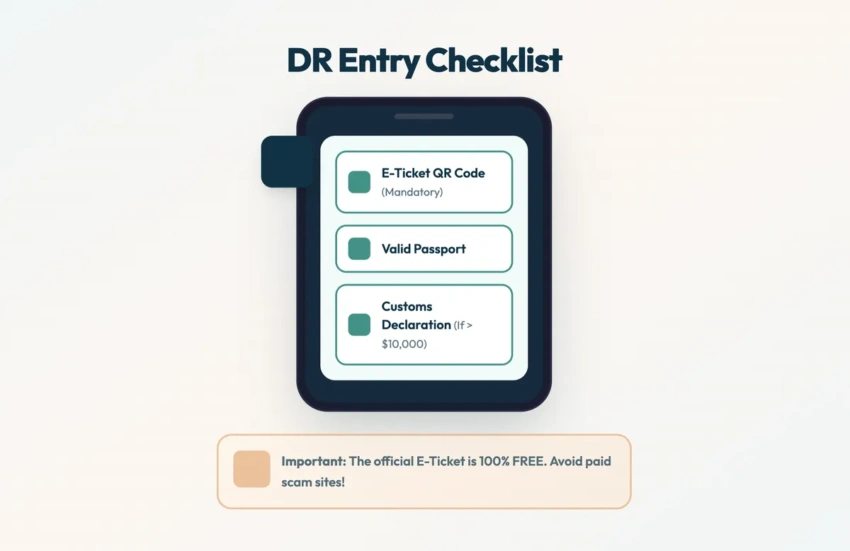
Essential documents you need to cross the DR border smoothly
The trap of paid third-party sites
One of the most common ways to lose money during the preparation phase is falling for E-Ticket scams. The official procedure through the government website is 100% free. However, search engines often display sponsored links to phishing sites or third-party intermediaries.
These platforms masquerade as official agencies and, at the final step, ask for your credit card details to pay a “processing fee,” which can range from $40 to $90 USD. Entering your information on these sites not only results in the loss of that money but also compromises your bank card.
Customs limits on cash
Before you arrive, it’s crucial to know exactly how much money you can legally bring into the Dominican Republic without declaring it. It strictly enforces policies regarding moving cash across its borders. The law does not limit the total amount you can bring into the country, but it does establish strict declaration rules.
- Mandatory declaration. Any amount equivalent to $10,000 USD or more must be declared to Customs and Border Protection officers upon arrival and departure.
- Forms of currency. This rule applies to paper banknotes, coins, traveler’s checks, and cashier’s checks, whether in US dollars or any other foreign currency.
- Joint declaration rule. The law strictly prohibits artificially splitting large sums among family members. If a family of three is carrying $15,000 USD, they must file a joint declaration (FinCEN Form 105), even though the amount per person is less than $10,000.
- Local currency. The import and export of the Dominican peso are officially prohibited.
Duty-free allowances for the Dominican Republic (per adult)
| Item category | Allowed limit | Notes |
|---|---|---|
| Cash | Under $10,000 USD | Amounts of $10,000 USD or more must be strictly declared. |
| Alcohol | Up to 3 liters | Permitted for wine, beer, or hard liquor. |
| Tobacco products | 200 cigarettes | Alternatively, one box of cigars is permitted. |
| Gifts and souvenirs | Up to $500 USD in value | Goods must be clearly intended for personal use and not for commercial resale. |
| Electronics | 1 laptop, 1 phone | For personal use; bringing in commercial quantities is subject to duty. |
Entering the DR requires paying a $10 USD tourist fee. For passengers arriving on commercial flights, this fee is already included in the ticket price. But if crossing the border by land, the fee is paid in cash at the checkpoint.
Understanding Local Currency – The Peso vs.
Foreign Money in the Dominican Republic
The official currency is the Dominican peso (international code DOP), issued and controlled by the Central Bank of the Dominican Republic (BCRD).
The historical context of the currency system’s formation is quite interesting: after gaining independence from Haiti in 1844, the peso was introduced; however, from 1905 to 1947, the US dollar served as the country’s official currency. This period left a lasting impact on the financial culture – the symbol for the Dominican peso is still denoted by the “$” sign, sometimes written as “RD$” to avoid confusion.
Identifying banknotes by color
The ubiquitous use of the “$” symbol on price tags often confuses foreign tourists. In supermarkets, pharmacies, and small shops, prices are listed in pesos, but because of the dollar sign, inexperienced shoppers might mistakenly assume the prices are in US currency.
To avoid misunderstandings, rely on the color-coding of the banknotes, which is a standard in the country. In 2026, coins of 1, 5, 10, and 25 pesos, as well as bills in denominations of 50, 100, 200, 500, 1000, and 2000 pesos, are in active circulation.
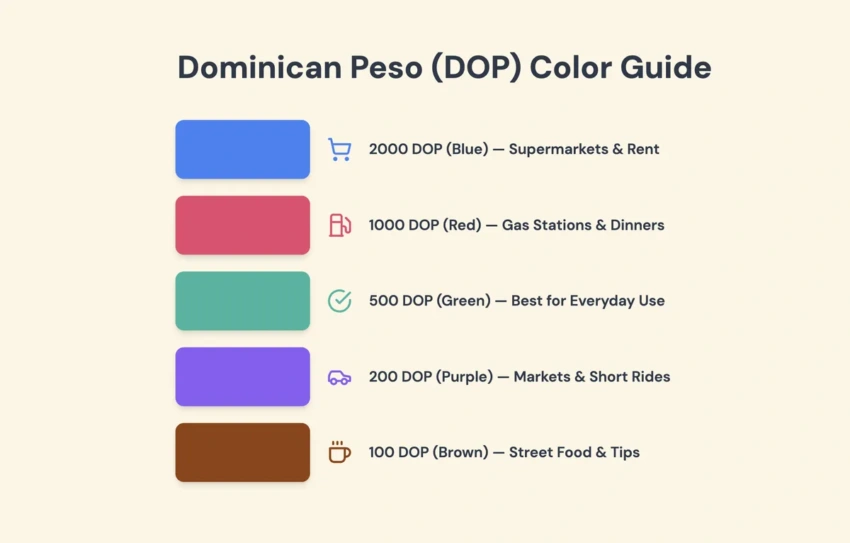
Learn the colors of local bills to avoid confusion when paying cash
Color identification and practical use of Dominican banknotes
| Banknote denomination | Main color of the bill | Optimal practical use |
|---|---|---|
| 2000 DOP | Blue | Paying large bills in supermarkets, paying for rental accommodations. Extremely inconvenient for street purchases. |
| 1000 DOP | Pinkish red | Gas stations, medium restaurant bills, paying for long taxi rides. |
| 500 DOP | Bluish-green | The most useful bill. Ideal for everyday transactions; minimizes the risk of price gouging. |
| 200 DOP | Pinkish purple | Buying fruit at the market, paying for short taxi rides, tipping tour guides. |
| 100 DOP | Brown | Tipping bartenders, buying small street food, paying for public transportation. |
The psychology of cash transactions: the change problem and the “wealth tax”
Economic practice in the Dominican Republic dictates a clear rule: small-denomination cash is king. Attempting to pay with a blue 2000-peso bill (~$34 USD) for a morning coffee costing 150 pesos or a bunch of bananas at the market will inevitably lead to a lack of change (cambio). Vendors in small shops or drivers of minibuses (gua-guas) simply do not have enough small bills on hand.
Furthermore, flashing large bills often triggers the phenomenon of artificial price inflation, known as “price gouging.” Upon spotting 1000 or 2000 peso notes in a tourist’s wallet, street vendors tend to instantly increase the original price of an item. It’s exactly why experienced travelers recommend carrying a sufficient supply of 100 and 500 peso bills.
US dollars vs. pesos – which should you choose?
Although USD is accepted in areas like Punta Cana, using foreign money in the Dominican Republic outside of resort grounds is almost always economically disadvantageous.
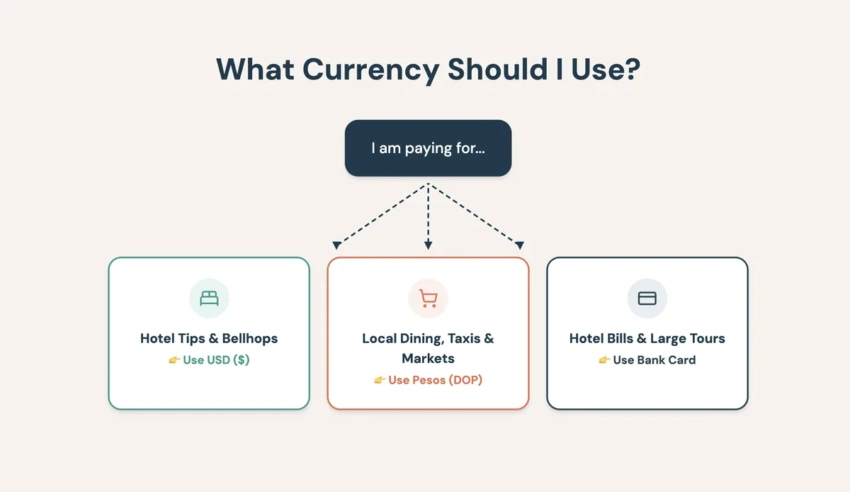
A quick reference on whether to use dollars, pesos, or plastic
Local restaurants, souvenir shops, and taxi drivers who accept dollars set their own exchange rates, which can be 10-15% worse than the official bank rate. Moreover, change is almost always given in Dominican pesos at the same unfavorable rate, leading to a double loss of funds. The only area where using dollars is absolutely justified and welcomed is tipping hotel staff, who gratefully accept $1 or $5 bills.
For all other transactions – public transport, groceries, restaurants, and paying metered taxis – having Dominican pesos is strictly mandatory.
Where to Exchange Money Safely
in the Dominican Republic
Since local currency is essential for a comfortable stay, finding a favorable exchange rate becomes a top priority. As of 2026, the exchange rate of the Dominican peso to the US dollar fluctuates between 58.8 and 59.8 DOP for 1 USD.
Places to exchange currencies for Dominican pesos
The currency exchange infrastructure in the Dominican Republic is well-developed, but different institutions offer vastly different terms:
- Official exchange offices (Casas de Cambio). Chains like Caribe Express, Global Exchange, or local spots (e.g., Jacks House Exchange in Punta Cana) offer highly competitive rates. The exchange process here takes just minutes, and queues are minimal. It is crucial to use only licensed exchange offices located in shopping malls or on main streets.
- Commercial banks (Banreservas, Banco Popular, BHD León, Scotiabank). They guarantee absolute security and offer official market rates. However, it involves a significant time commitment. Banks are often crowded with locals and operating hours are limited. To exchange money, you will need your original passport.
- Hotel and resort front desks. The main drawback is the poor exchange rate. Hotels factor their own commission into the rate, which can reach 5-10%. This option is suitable for exchanging small amounts for urgent expenses or tips.
- Exchange kiosks in the arrivals area (e.g., at Punta Cana Airport) offer the worst exchange rates in the country. It is strongly recommended to exchange only the bare minimum here ($20-30) – just enough to pay for a taxi or initial tips – and exchange the bulk of your funds once you are in the city.
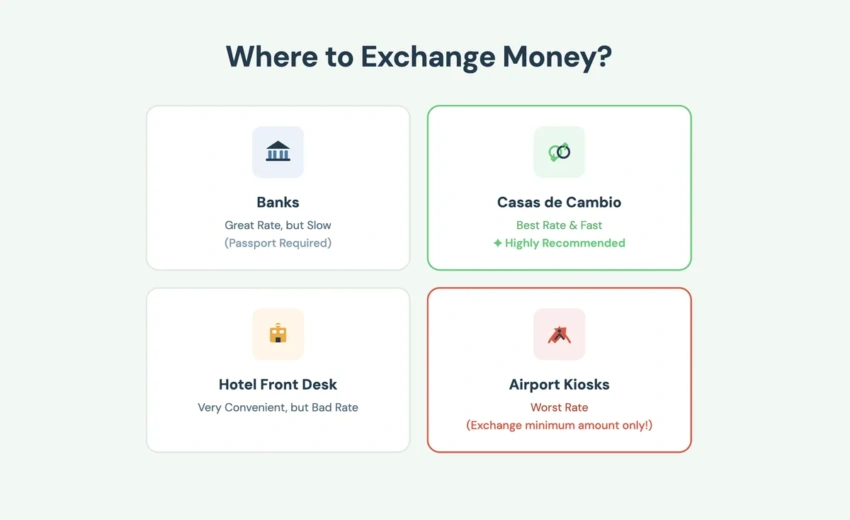
Skip the airport kiosks and head to Casas de Cambio for the best exchange rates
We don’t recommend exchanging money with strangers on the street or at the beach. Such deals often end with receiving counterfeit bills, being shortchanged by sleight of hand, or the tourist being subsequently robbed after flashing a large sum of cash.
Bank Cards & Digital Money
in the Dominican Republic in 2026
Digital payments are growing rapidly, but paper money remains essential for everyday transactions across the Dominican Republic. In major cities (Santo Domingo, Santiago) and tourist hubs, credit and debit cards are accepted universally.
Acceptance of plastic cards
Visa and Mastercard payment systems are the absolute standard and are accepted in supermarkets, gas stations, major restaurants, and sports stadiums. The American Express system has a narrower reach and is accepted primarily in luxury hotel chains and high-end boutiques.
An important aspect is notifying your home bank about your upcoming trip in advance. Many banks’ security algorithms automatically block cards when they detect transactions from Caribbean countries, suspecting data compromise. A quick call to the bank or setting a “Travel Notice” in your mobile app will eliminate the risk of being left stranded without funds.
Additionally, you should check the size of your foreign transaction fee, which can range from 1.5% to 3% for each purchase. If your card charges a high fee, using cash will be a more cost-effective strategy.
In the premium services sector and real estate transactions, cards are accepted reluctantly. Law firms handling documents for expats prefer bank transfers or cash deposits made directly at a bank branch to avoid incurring fees.
Contactless payments: Apple Pay, Google Pay, and digital wallets
In 2026, contactless technologies have become an integral part of retail in the Dominican Republic. The global shift toward digitalization has led to digital wallets accounting for up to 54% of transactions in the e-commerce sector.
A local breakthrough was the official integration of Apple Pay support by one of the country’s largest banks, Banco Popular Dominicano. The technology uses a Secure Element and tokenization, preventing the transmission of the actual card number to the merchant and enhancing purchase security.
Where you can pay with your smartphone
Practice shows that paying via Apple Pay and Google Pay works perfectly in the following places:
- Major supermarket chains. National retail leaders such as La Sirena (including the Jumbo format) and Nacional have equipped their checkout counters with modern NFC terminals.
- Pharmacy chains. Most large pharmacies located in shopping malls support contactless payment at the main registers.
- Fast-food chains and gas stations. International franchises (McDonald’s, Starbucks) and modern gas stations (Shell, Esso) accept digital wallets without issue.
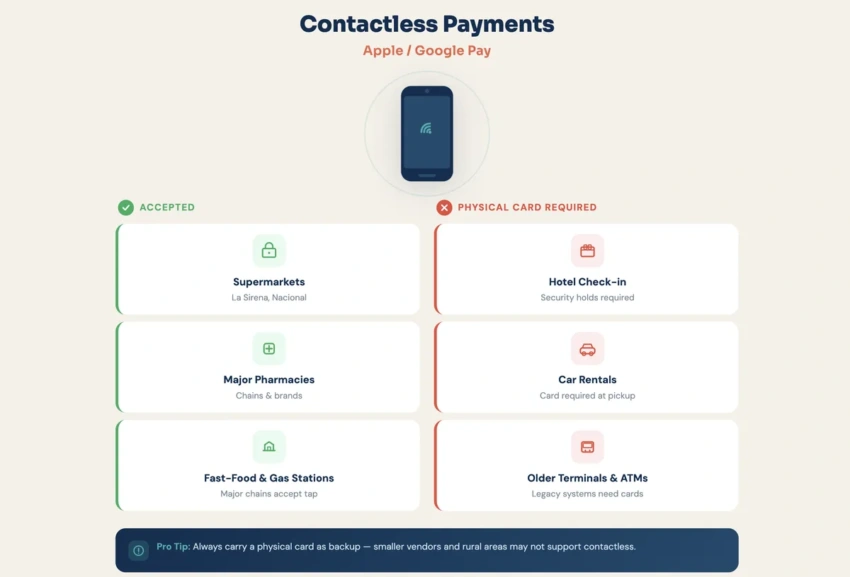
Where you can tap your phone and when you actually need a physical card
However, relying exclusively on your smartphone is not recommended. Many hotels require a physical plastic card with an embossed name for pre-authorizing a deposit (a hold) upon check-in, as do car rental companies. The virtual card numbers generated by Apple Pay may not match the physical number, leading to system conflicts with older hotel terminals. A physical card should always be kept as a backup.
The UnionPay payment system
Due to the diversification of tourist flows and the development of trade relations, the integration of the Chinese payment system UnionPay is growing in the Dominican Republic. UnionPay cards are accepted by tourism providers via the Amadeus system and at several ATMs across the country.
However, cardholders from mainland China must keep in mind the strict limits set by the State Administration of Foreign Exchange (SAFE): overseas cash withdrawals are capped at the equivalent of 10,000 RMB per day and 100,000 RMB per year per person.
Fees and Limits for ATMs and Money in the Dominican Republic
Withdrawing cash from ATMs is often pitched as the safest and most cost-effective way to get local currency. ATMs dispense exclusively Dominican pesos at the exchange rate set by international payment systems. Nevertheless, mindless use of ATMs can lead to colossal overpayments.
Withdrawal limits
Most banks set a strict limit on cash withdrawals in a single transaction, which in 2026 stands at 10,000 Dominican pesos (about $170-$180 USD). This means that to get a larger sum, you will have to make multiple transactions, each of which will incur a fee.
Comparative analysis of local bank fees
When using a foreign bank card, withdrawing funds involves multiple layers of fees: a fee from your own bank, a currency conversion fee, and a fee from the local bank that owns the ATM. The situation with local fees in the Dominican Republic is as follows:
Comparison of major ATM network fees (as of 2026)
| ATM network | Local fee (estimated) | Standard per-transaction limit | Viability analysis |
|---|---|---|---|
| Banreservas | 300 DOP | 10,000 DOP | A state-owned bank with the widest network. The fixed fee of 300 pesos (about $5 USD) makes this option one of the most reliable and transparent when withdrawing the maximum amount. |
| Scotiabank | 0 DOP (Global ATM Alliance); otherwise varies | Up to 10,000 DOP | A Canadian bank offering free cash withdrawals for cards from Global ATM Alliance partner banks (though a 2% network fee may still apply). For other cards, the standard fee is charged. |
| Banco Popular / BHD León | From 8% to 10% of the withdrawal amount, or a high fixed fee | 10,000 DOP | In tourist areas, ATMs from these networks frequently apply high surcharges for servicing foreign cards. Carefully review the fee confirmation screen. |
| Independent street ATMs | 10% and higher + hidden fees | Varies | Strictly not recommended. Opaque pricing and a critically high risk of skimming devices being installed. |
The math of overpaying and the DCC trap
A striking example of financial carelessness is a case where a tourist urgently needed a small amount of money. When withdrawing 2,100 pesos (equivalent to 50 Canadian dollars), factoring in the home bank’s fee ($5 CAD + 2.5%), the local ATM fee (300 DOP, equivalent to $7 CAD), and the additional markup for conversion, the total cost of the transaction came to $63.25 CAD. The effective fee exceeded 26.5% of the withdrawn amount.
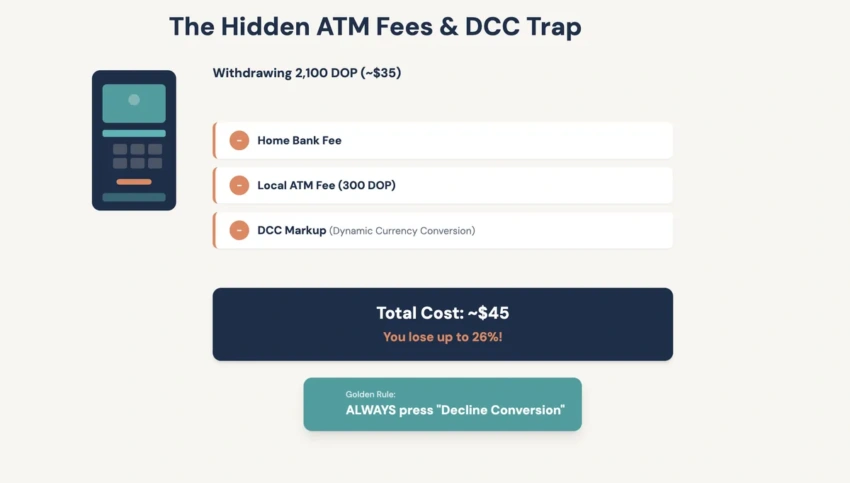
Always press “Decline Conversion” to save up to 26% on cash withdrawals
The conclusion is obvious: using ATMs makes economic sense only when withdrawing the maximum limit of 10,000 pesos at a time. This dilutes the fixed fee down to an acceptable 3-4%.
Another major trap is Dynamic currency conversion (DCC). During the withdrawal process, the ATM may offer to lock in the charge amount in dollars or euros at the bank’s own exchange rate. This rate is always extremely unfavorable for the tourist. The golden rule for using ATMs abroad: always select the option to “Proceed without conversion” or “Decline conversion.” In this case, the exchange will be processed at the fair wholesale rate set by Visa or Mastercard.
Money safety tips for solo travelers
Exploring the country alone requires extra caution with finances. Basic rules backed include:
- Never carry all your cash and your passport with you. Only take a “daily allowance” that you wouldn’t be devastated to lose.
- Use money belts or anti-theft crossbody backpacks, wearing them on your chest in crowded places.
- Strictly avoid wearing expensive watches, gold jewelry, or flashing the latest smartphone models in non-tourist areas. Any display of wealth makes you a target.
- After dark, only walk on well-lit, busy streets or use taxis (preferably Uber), avoiding solo walks through unfamiliar neighborhoods.
Tipping Culture & How to Manage Your Money
in the Dominican Republic’s Resorts
The Dominican Republic has a service-based economy, with a significant portion of the population living below the poverty line and average monthly salaries not exceeding $600. Under these conditions, tips (propina) are not just a sign of politeness but a critically important part of hospitality workers’ income.
Restaurant taxation: understanding your bill
Dining at cafes and restaurants outside of all-inclusive hotels often comes with a surprise when the bill arrives. The prices listed on the menu are generally not final. The country’s laws require establishments to add an 18% value-added tax (ITBIS) to the bill, along with a mandatory 10% service charge. Combined, the final bill increases by nearly 30%.
Despite the included 10% service charge, proper etiquette dictates leaving an additional cash tip directly for your waiter if the service was good. It is customary to add 5% to 10% to the final bill amount.
Recommendations for budgeting tips at resorts
Even if a traveler has purchased an “Ultra All-Inclusive” package, small cash tips drastically change the staff’s attitude and the quality of service you receive. For a one-week vacation for a couple, it is recommended to budget around $150 USD (or the equivalent in pesos) exclusively for tips, breaking it down into small bills in advance.
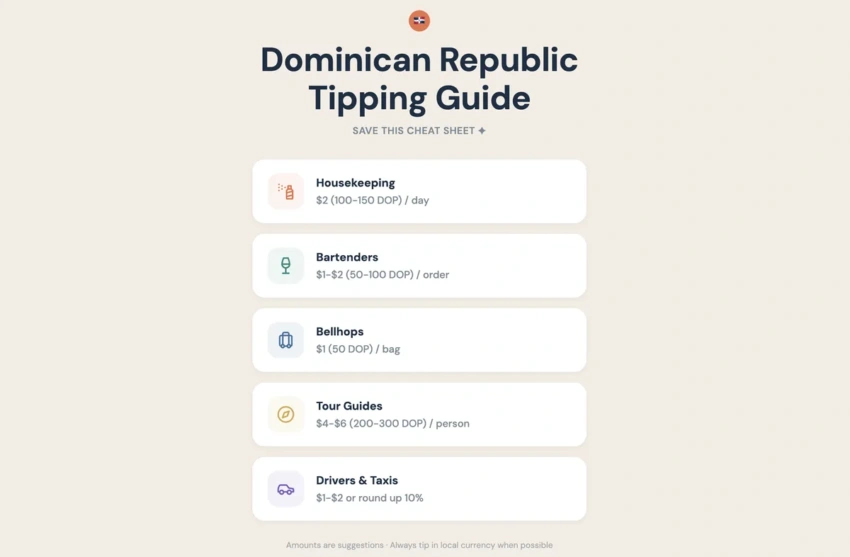
Save this tipping guide to thank hospitality workers appropriately
Recommended tipping amounts
| Service category | Tip amount (USD / DOP) | Nuances & tips |
|---|---|---|
| Housekeeping | $2 (100-150 DOP) per day | Leave the money daily on your pillow or nightstand, preferably with a short note (e.g., “Para limpieza”) to avoid misunderstandings. |
| Pool / lobby bartenders | $1-$2 (50-100 DOP) per order | Strategy: tip the same bartender from day one. This guarantees priority service and better cocktails for the rest of your trip. |
| Bellhops | $1 (50 DOP) per bag | Paid upon delivery of luggage to your room at check-in and check-out. |
| Tour guides | $4-$6 (200-300 DOP) per person | For a half-day tour. Double the amount for a full-day tour. |
| Tour bus drivers | $1-$2 (50-100 DOP) per couple | Left when exiting the bus at the end of a transfer or tour. |
| City taxis | Round up or 10% | If the driver helped with heavy luggage or the ride was comfortable and safe, it is customary to add 50-200 pesos to the fare. |
| Buffet chefs | $1 (50 DOP) | For making a custom omelet or a grilled dish. |
It is preferable to leave tips in Dominican pesos so the staff doesn’t have to spend time and lose a percentage exchanging currency. However, US dollars are also happily accepted. Foreign coins (like euro cents or Canadian dollars) should never be given – they cannot be exchanged at local banks.
Prices and Vacation Costs as of 2026
To budget effectively in the Dominican Republic, understand the local pricing structure. Being an island economy means that local goods (fruits, vegetables, local rum) are very cheap, while any imported goods, electronics, gasoline, and delicacies can be more expensive than in the US or Europe.
Daily expenses depend heavily on your travel style:
- Budget travelers (taking buses, staying in hostels, eating street food) can expect to spend around $80 a day (about 3,410 DOP).
- Mid-range travelers (Airbnb rentals, dining at restaurants, taking excursions) will need around $204 a day (8,735 DOP).
- Luxury vacations (car rentals, private tours, fine dining) start at $529 a day.
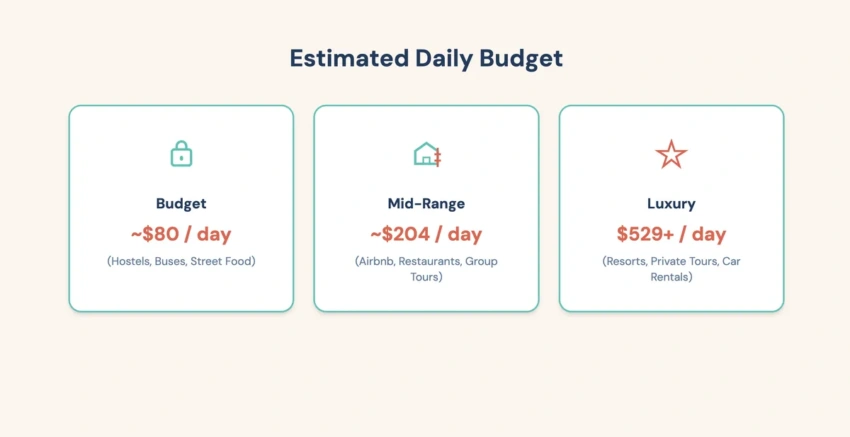
Average daily costs based on your preferred travel style
Supermarket grocery prices
To get a feel for local prices, visit a large local supermarket, such as the La Sirena chain (like the Luperón branch in Santo Domingo or locations in Punta Cana). For 2026, prices for basic groceries can be found here. Here are the main ones:
Prices for popular items at La Sirena supermarkets (DOP)
| Item name | Price in Pesos (DOP) | Approx. equivalent in USD |
|---|---|---|
| Local red onion (Cebolla roja criolla), 1 lb | 49.00 | ~$0.83 |
| Local baked bread (Pan de agua buenhorno), 10 ct. | 55.00 | ~$0.93 |
| Gatorade fruit punch sports drink (600 ml) | 60.00 | ~$1.01 |
| Jumbo white eggs (1 dozen) | 130.00 | ~$2.20 |
| Mozzarella cheese (queso mozzarella Wala), 1 lb | 214.00 | ~$3.62 |
| Dutch Gouda cheese (queso Gouda Holandés), 1 lb | 325.00 | ~$5.50 |
| Coca-Cola (1.25 liters) | 72.00 | ~$1.22 |
| Colgate toothpaste (75 ml) | 105.00 | ~$1.77 |
Dining outside also offers a wide price range. A traditional street snack (empanadas or tostadas) will cost just 75-150 pesos. A cup of coffee (latte) at a cafe is about 150 pesos. A good lunch for one at a mid-range restaurant will cost between 690 and 1,000 pesos, while a Mojito at an upscale bar runs around 350-400 pesos.
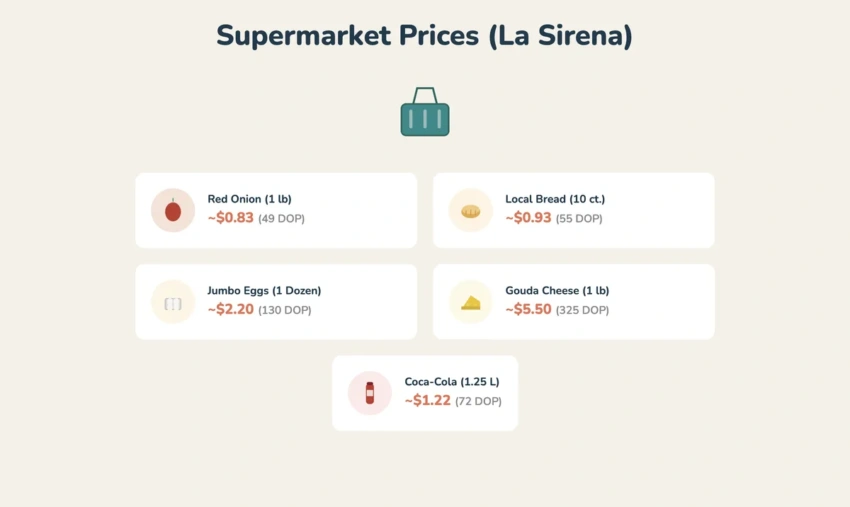
Current prices for basic groceries if you plan to cook at your rental
The cost of souvenirs depends on your ability to haggle. Haggling is expected everywhere, except in supermarkets with fixed prices and banks. When buying paintings, cigars ($5 to $100), or rum at markets, you can often knock the initial price down by 30-50%.
Financial Security and Your Money
Protection in the Dominican Republic
With a Level 2 travel advisory from the US State Department, violent crimes against tourists in resort areas are extremely rare thanks to patrols by the tourist police (POLITUR). Tourists who are careless with their money can easily fall victim to common scams in the Dominican Republic. Knowing the main scam patterns is your best investment in safety.
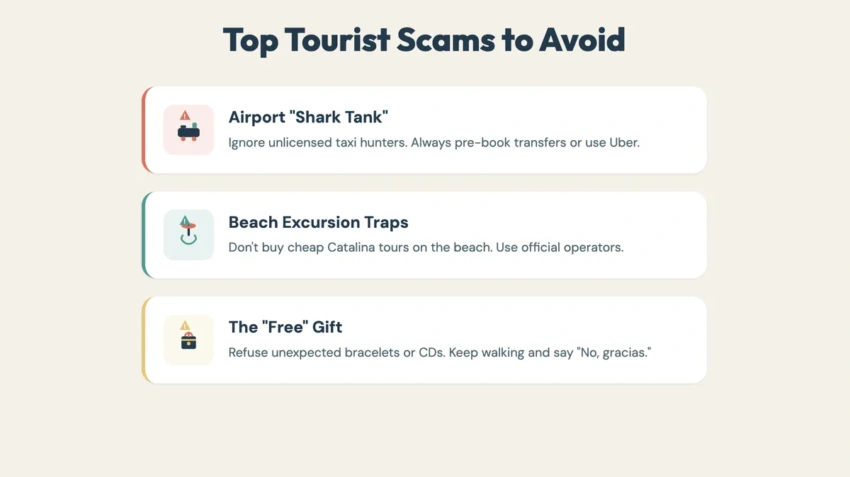
Stay alert and avoid these common traps at the airport and beaches
1. Transport traps: the “shark tank” and the “broken meter”
Upon exiting the terminal at Punta Cana Airport, tourists walk into an area local expats refer to as the “Shark tank.” Dozens of unlicensed touts rush travelers, trying to grab their suitcases and falsely claim they are their pre-booked transfer service. Their goal is to get the tourist into their car and demand an astronomical sum – for example, $80 for a 20-minute ride to Bavaro. They may convincingly lie that ride-share apps like Uber are illegal or blocked at the airport.
- The solution. Completely ignore the touts, never let go of your luggage, and use a pre-booked transfer or request an Uber by walking to the official pickup zone. We highly recommend booking a licensed Punta Cana airport transfer through with us. We cooperate exclusively with reliable, licensed companies, guaranteeing transparent pricing with no hidden fees.
-
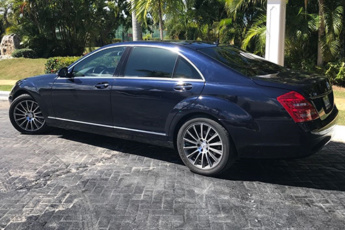
Mercedes s350 VIP Transfer in Punta Cana
from $126 View Details -
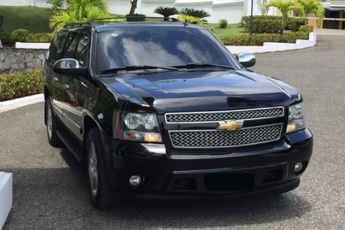
Chevrolet Suburban – VIP Transfer
from $97 View Details -
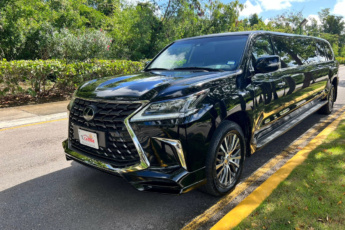
Limo – VIP Transfer
from $310 View Details -
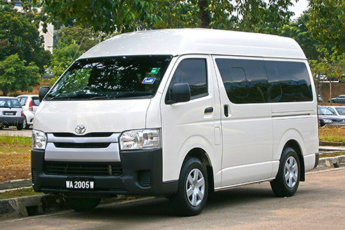
Passenger Car or Minibus Up to 4 People
from $48 View Details -
SUV or a Minivan (up to 6 People)
from $58 View Details -
Minibus Transportation Up To 8 People
from $68 View Details
A professional driver will be waiting for you right at the arrival gate to help with your luggage and take you straight to your accommodation. Whether you need a comfortable car for a couple, a minivan for a group of up to 8 people, or even a VIP limousine to celebrate a special occasion, you get top-quality service at reasonable prices.
When using street taxis in cities, the “Broken meter” scam is common. The driver agrees to use the meter, but halfway through the trip suddenly claims the device is broken or that a “night rate” has started, demanding two or three times the agreed-upon amount.
- The solution. Always firmly agree on the final, fixed price before getting into the vehicle. The ideal alternative is using the Uber app, which eliminates the language barrier, provides GPS tracking, and charges a pre-known fixed amount to a linked card. Or you can rent a car and not worry about anything else!
-
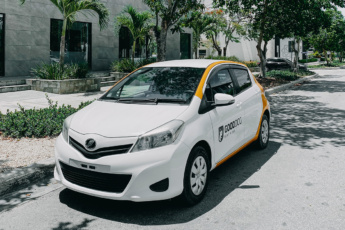
Toyota Vitz Rent a car in Punt Cana
from $59 View Details -
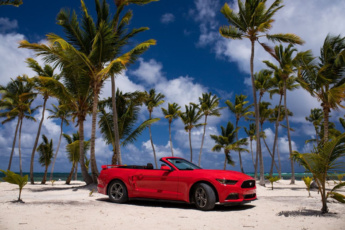
Ford Mustang Convertible Car Rentals in Punta Cana
from $180 View Details -

Kia Optima Cheap car rentals in Punta Cana
from $75 View Details -
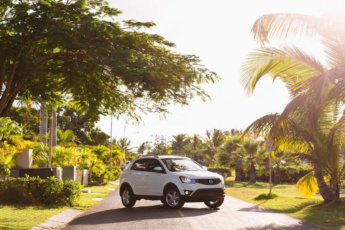
SsangYong Tivoli Hire a car in Punta Cana
from $85 View Details -

Chevrolet Camaro Convertible Luxury car rental in Punta Cana
from $120 View Details
2. The dangers of informal excursions: the Catalina Island trap
Purchasing excursions from street vendors or random operators on the beach often results in lost time and money. A prime example is the widespread diving scam targeting Catalina Island. Tourists are promised a proper 2-tank dive and shown beautiful brochures at stationary tents near the beaches (such as Plaza Bibijagua).
After paying, the logistical nightmare begins: instead of a direct ride on a comfortable bus, tourists are shuttled from one cramped van to another at random gas stations, driven around remote non-tourist areas for hours, and forced to stop at “friendly” souvenir shops in the hopes they will spend money. Upon reaching the boat, they discover there will be no scuba diving – only a 15-minute snorkeling session is offered.
The group of 100 people is then crammed onto a boat built for 20, often without life jackets, and dropped off on Catalina Island for 4 hours with no way to return early. On the island, tourists are harassed by local vendors selling questionable food and goods at triple the price. The result of this 12-trip is stress, food poisoning, and zero resemblance to the promised itinerary.
- The solution. Purchase excursions only from reputable tour operators like EverythingPuntaCana, at the hotel front desk, or through trusted online platforms with verified reviews.

Fantastic Private Boat Tour (from Cap Cana) – With Fishing & Snorkeling
from $1795 View Details
Private Catalina Island Full-Day Tour by Speedboat – Snorkeling, Personal Guide
from $860 View Details
Catalina Island Day Trip: the Best Snorkeling Experience
from $90 View Details3. Street hustles and card manipulation
- The “free” gift scam. While walking through the Colonial Zone or along the beach, a tourist is suddenly handed a bracelet, CD, or figurine with the words: “This is a gift as a sign of friendship.” As soon as the item is in the foreigner’s hands, the “well-wisher” instantly changes their tone and demands a “donation.” Trying to give the item back is met with an aggressive refusal to take it. The only defense is to keep your hands to yourself and firmly say, “No, gracias” without stopping.
- “Sanky panky” (romance scams). Charismatic locals professionally seduce lonely tourists. After a whirlwind vacation romance, they start asking for money for “urgent medical care for a sick mother,” “an investment in a lucrative local business,” or to pay visa fees to move to the tourist’s home country. This is a well-oiled industry based on psychological manipulation.
- Card skimming. The installation of card-cloning devices on street ATMs is a serious issue. Never use standalone ATMs on dark streets or in unguarded shopping centers. Only ATMs located inside bank branches with video surveillance or in the lobbies of prestigious hotels are considered safe. Always cover the keypad with your hand when entering your PIN to protect against hidden micro-cameras.
International Money Transfers in the DR
For expats or those who urgently need to transfer money to the Dominican Republic, finding a reliable service is highly relevant. Traditional SWIFT bank transfers are expensive and can take up to 5 business days.
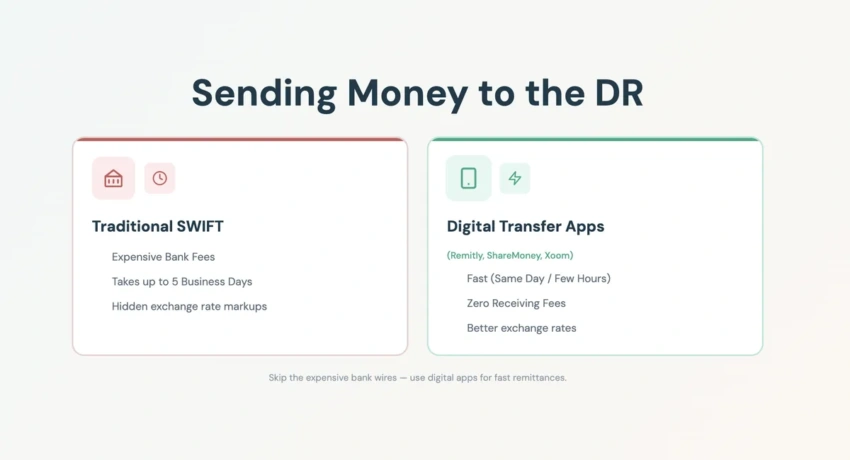
Skip the expensive bank wires and use digital apps for fast remittances
In 2026, the optimal solutions are money transfer services like Western Union, Remitly, Xoom, and ShareMoney, which are integrated with local Dominican banks. For example, when sending money to a relative or to yourself from the US to a Banreservas account via ShareMoney, you can use a debit card. The funds are credited within a few hours (often by lunchtime the same day).
All that is required for the transfer is the recipient’s full legal name (exactly as it appears on their ID) and their bank account number (usually 10 to 13 digits). The recipient in the Dominican Republic pays zero fees to receive the funds, and the exchange rate is locked in at the moment of sending. The received funds can then be withdrawn at any Banreservas branch or ATM using a local bank card.
Final Recommendations for Managing
Money in the Dominican Republic
Summarizing this deep dive into the financial ecosystem of the DR, we can outline a few golden rules that will keep both your budget and your nerves intact:
- Diversification is key. The ideal strategy involves combining several methods: an international bank card (preferably with no foreign transaction fees) for large expenses (hotels, supermarkets), digital wallets (Apple Pay/Google Pay) for quick and secure purchases in modern retail, and an ample supply of small-denomination pesos (100 and 500 bills) for transport, street food, and tips.
- Smart ATM use. When you need to restock cash, only use ATMs located inside official bank branches (Banreservas, Scotiabank). To minimize the impact of fixed fees, withdraw the maximum allowable amount (10,000 DOP) in a single transaction, and always decline the Dynamic Currency Conversion (DCC) offered by the machine.
- Healthy skepticism. Any financial offer on the street – from a great exchange rate from a passerby to an unbelievably cheap beach excursion – is a scam 99% of the time. When dealing with money in the Dominican Republic, remember that the only free cheese is in a mousetrap, and it snaps shut along with your wallet.
- The digital wall. Using mobile apps like Uber for taxis or official government websites for your E-Ticket creates a reliable digital barrier between your wallet and street scammers, ensuring transparent and fixed pricing.
The Dominican Republic is a beautiful, hospitable country with a rich culture. Applying the financial strategies outlined above will allow you to focus on enjoying the Caribbean Sea, the palm trees, and the local rum, leaving any money troubles far behind.
FAQ about Money
in the Dominican Republic
What's the best currency to take to the Dominican Republic?
The best strategy is to bring US dollars (USD) for your trip, but the best currency to actually use for daily expenses is the Dominican Peso (DOP).
- Bring USD for exchanging at local banks or Casas de Cambio, tipping resort staff, and paying for pre-booked transfers.
- Use DOP for shopping at supermarkets, dining at local restaurants, taking public transport, and buying from street vendors.
How far does $1 go in the Dominican Republic?
At the current exchange rate, $1 USD is equal to about 58-60 Dominican pesos. While it won’t buy you a full meal, $1 can cover several small expenses:
- A tip for a bellhop carrying your bag.
- A bag of local bread at a supermarket.
- A pound of local red onions at a grocery store.
- A small street food snack or a short public transport ride.
Can I use euros in the Dominican Republic?
Yes, but they are not recommended for daily payments.
- You can easily exchange Euros for Dominican pesos at official exchange offices (Casas de Cambio) and banks.
- Unlike US dollars, most local shops, taxis, and restaurants will not accept Euros directly for payment.
- Always exchange your Euros for local currency rather than trying to spend them on the street.
Is it better to pay in USD or Dominican pesos?
For almost all everyday expenses outside of your resort, it is always better to pay in Dominican pesos.
- Local vendors, restaurants, and taxis set their own exchange rates if you pay in dollars, which can be 10% to 15% worse than the official bank rate.
- If you pay with US dollars, your change will almost always be given to you in Dominican pesos at that same poor rate, resulting in a double loss.
US dollars are perfectly fine (and welcomed) for tipping hotel staff like maids and bartenders.
Should I exchange currency before traveling to Dr.?
No, you should wait until you arrive.
- The import and export of the Dominican peso is officially prohibited by law.
- It is best to bring US dollars or Euros and exchange them once you are in the country.
Exchange only a bare minimum amount ($20-$30) at the airport kiosks, as they offer the worst exchange rates. Exchange the bulk of your vacation money at official Casas de Cambio in the city.
Is $10 USD a good tip in the Dominican Republic?
Yes, $10 USD is considered a very generous tip and is highly appreciated, especially since the average local salary is under $600 a month.
- For bartenders, bellhops, and daily housekeeping, a standard tip is usually between $1 and $2.
- $10 is perfect for rewarding exceptional service, such as tipping a tour guide for a full-day excursion or a private driver who helped with heavy luggage and provided a safe, comfortable ride.
Do you have to pay $20 to leave the Dominican Republic?
Based on current regulations, the official E-Ticket required for both entering and leaving the country is 100% free.
There is a $10 USD tourist fee for entering the country, but if you are flying on a commercial airline, this fee is already included in the price of your plane ticket.
Beware of third-party scam websites that try to charge “processing fees” of $40 to $90 for the E-Ticket—always use the free official government portal.
Is 20 pesos a good tip?
No, 20 Dominican pesos is generally considered too low, as it is equivalent to only about 30–35 US cents.
- The minimum recommended tip for small services, such as a bellhop carrying your bag or a buffet chef making a custom omelet, is 50 DOP (about $1 USD).
- For bartenders, it is customary to leave 50 to 100 DOP per order.
- For daily housekeeping, you should aim for 100 to 150 DOP per day.
Should I charge my card in pesos or USD?
You should always choose to be charged in the local currency (Dominican pesos).
- Many ATMs and card terminals use a trap called Dynamic Currency Conversion (DCC), offering to lock in your charge in USD at their own exchange rate.
- This rate is always extremely unfavorable and can cost you significantly more.
Always select “Decline conversion” or “Proceed without conversion” on the screen. This allows your home bank to process the transaction at a much fairer wholesale rate.
Is $200 Dominican pesos a good tip?
Yes, 200 DOP (roughly $3.40 USD) is a very solid and appreciated tip for several specific services.
- It is the recommended starting tip for a tour guide on a half-day excursion (usually 200-300 DOP per person).
- It is also a generous tip to add to your city taxi fare if the driver provided a safe ride or helped you with heavy luggage.
- You can also use a 200 DOP bill to tip a bartender who has been providing you with excellent priority service throughout the day.
Is it better to exchange money at the airport or in the country?
It is definitely better to exchange your money in the country at official locations.
- Exchange kiosks in the airport arrivals area offer the worst exchange rates in the entire country.
- You should only exchange a bare minimum amount at the airport (around $20–$30) to cover your immediate taxi ride or initial tips.
For the bulk of your vacation funds, use official exchange offices (Casas de Cambio) or local commercial banks located in the city or shopping malls, as they offer highly competitive and fair rates.
Can I use my debit card in the Dominican Republic?
Yes, you can easily use your debit card, especially if it operates on the Visa or Mastercard network.
- They are universally accepted at major supermarkets, large restaurants, gas stations, and tourist hubs.
- You can safely use them at local ATMs to withdraw Dominican pesos.
Remember to set a “Travel Notice” in your mobile app or call your home bank before your trip. Otherwise, their security algorithms might flag your Caribbean transactions as fraudulent and block your card.
How much money should I bring with me to the Dominican Republic?
The amount depends heavily on your travel style and whether your accommodation is already paid for:
- Budget travelers (hostels, street food, public transport) should plan for about $80 USD per day.
- Mid-range travelers (Airbnb, restaurants, group excursions) will need around $204 USD per day.
- Luxury vacations (resorts, private tours, car rentals) start at $529 USD per day.
- If staying at an all-inclusive bring about $150 USD in small bills strictly for tipping staff over a one-week trip for a couple.
You can legally bring any amount of money, but you must declare cash totaling $10,000 USD or more at customs upon arrival.
How do I avoid 3% foreign transaction fee?
Foreign transaction fees can drain your travel budget, but you have a few ways to avoid them:
- If your current card charges a high fee (up to 3%), relying on cash for your daily purchases will be a much more cost-effective strategy.
- Before your trip, apply for a credit or debit card that explicitly offers “zero foreign transaction fees.”
- When withdrawing cash, ATMs may offer to lock in the exchange rate (DCC). Always press “Decline conversion” to let your own bank process the transaction at a fair wholesale rate, saving you from massive hidden markups.
Is it better to pay a hotel in local currency?
Yes, whenever you are paying with a credit or debit card, you should ask to be charged in the local currency (Dominican pesos).
- If a hotel’s payment terminal offers to convert your bill to USD (Dynamic Currency Conversion), it will do so at the hotel’s or local bank’s exchange rate.
- This rate is almost always extremely unfavorable for the tourist and acts as a hidden fee.
- By choosing to pay in pesos, your home bank will handle the conversion at a much fairer, wholesale rate.
What happens if you don't tip at an all-inclusive resort?
Nothing bad will happen, and you will still receive standard service, but you will miss out on the “VIP” experience.
- Because the average local salary is very low, tips are a critically important part of the income for hospitality workers.
- Small cash tips drastically change the staff’s attitude and elevate the quality of service you receive.
- For example, tipping a bartender $1-$2 on your first day often guarantees priority service and better drinks for the rest of your trip.
Updated on: . Author: