

Do You Need Vaccinations for the Dominican Republic? – 2026 Health & Safety Guide
The Dominican Republic welcomes over 11 million tourists annually. It’s the most popular destination in the Caribbean. But along with the tickets, many tourists also buy anxiety: “Are vaccinations necessary to travel to the Dominican Republic?” “Is there malaria?” or “What about diarrhea?”
Health & Safety Guide for the Dominican Republic
The internet is full of contradictions. Some websites warn of tropical fevers, while others recommend rum as a cure. To avoid confusion, let’s look at medical facts, CDC statistics, and real-life experiences. Save yourself stress before your trip and money during it.
1. Bureaucracy & the Border –
What Is Officially Required?
The first thing you need to know: the Dominican Republic is a country that thrives on tourism. It’s not in their interests to make your life difficult.
Do I need a certificate with seals?
Officially: no. Citizens of Europe, the United States, Canada, and the CIS countries do not require vaccinations to enter the Dominican Republic. At passport control at Punta Cana Airport (PUJ), officers only check your passport and e-ticket. No one will look at your vaccination certificate.
Yellow fever – the only exception
There’s one caveat regarding transit. If you’re arriving from a country experiencing a Yellow fever outbreak, you may be required to provide a vaccination certificate.
- Risk areas: Brazil, Venezuela, the Democratic Republic of Congo, and some other countries in Africa and South America.
- Important! If you’re flying, for example, from Europe with a layover in Panama or Brazil and disembarking in a city there (transit time longer than 12 hours), you may need a certificate. This requirement does not apply to direct flights or layovers in the US or Europe.
The Malaria Myth (Numbers and Geography)
This is the most common fear. “There’s malaria in the Dominican Republic!” scream the headlines. Let’s look at the facts:
- The island of Haiti is divided into two countries: poor Haiti and the tourist-heavy Dominican Republic.
- 95% of malaria cases are recorded on the western border, closer to Haiti.
- Punta Cana is located in the far east, as far away as possible from the hotspots of infection.
- According to the CDC, the risk of malaria in the province of La Altagracia (where Punta Cana is located) is assessed as “Very Low.” Tourists staying in hotels are not officially recommended to take malaria prophylaxis tablets (which are very harmful to the liver).
2. Recommended Vaccinations for the DR –
Your “Gold Standard” of Safety
Even if you’re not required to provide a certificate at the border, international organizations (CDC, WHO) and insurance companies recommend this kit.
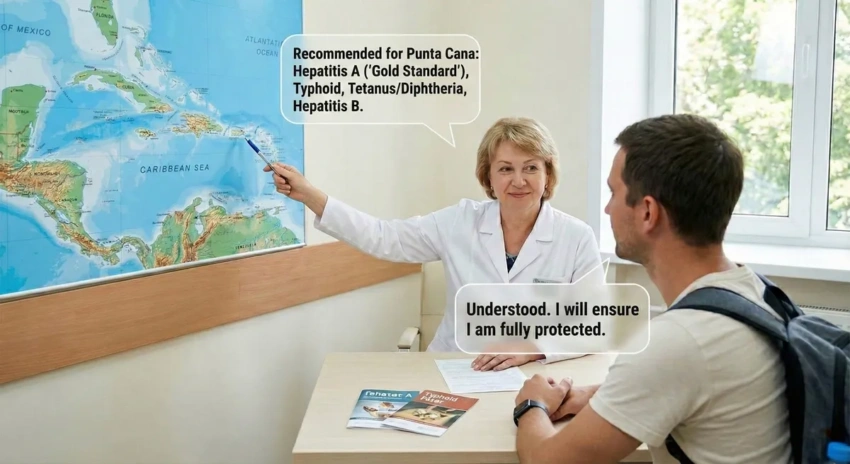
List of recommended vaccinations for the Dominican Republic
Why? Because your immune system, accustomed to the home environment, may not be able to cope with tropical bacteria in the Dominican Republic without proper vaccinations.
Top 4 vaccines you may need before traveling to the DR
| Vaccine | Source | Who is at risk? | Schedule & expert tip |
|---|---|---|---|
| Hepatitis A | Contaminated water, ice cubes, food. | High. The #1 traveler’s disease. | 2 doses. Even 1 dose before flight offers high protection. Virus survives freezing! |
| Typhoid Fever | Bacterial infection from food/water. | Medium. Higher risk for street food lovers and countryside tours. | Valid for 2–3 years. Vaccine is not a substitute for hygiene (wash your hands). |
| Tetanus | Soil, dust, rusty metal (e.g., nails). | High. Tropical wounds heal slowly; spores live in soil for years. | Every 10 years. Check your last booster date before you pack. |
| Hepatitis B | Blood and bodily fluids. | Specific. Long stays, tattoos, new partners, or dental care. | 3 doses. Consider the Twinrix (Hep A + B) combo vaccine for convenience. |
Hepatitis A – the most common threat
This is a viral liver disease that doctors call “traveler’s disease number one.”
- How it’s spread: through water, food, or dirty hands.
- Hidden danger: the Hepatitis A virus is incredibly resilient. It doesn’t freeze. This means that an ice cube in your cocktail (if it’s made with untreated water) can be a source of infection, even if the drink itself contains alcohol.
- Statistics: according to epidemiologists, the risk of contracting Hepatitis A in an unvaccinated traveler in developing countries is 100 times higher than the risk of typhoid fever.
- Tip: vaccination is administered in two doses (6-12 months apart), but even a single dose administered two weeks before departure provides nearly 95% protection.
Typhoid fever – for researchers
This is an acute bacterial infection.
- Who really needs it: if you want to try authentic street food, go to Santo Domingo, or go on a tour into the countryside, the risk increases dramatically, so this becomes one of the useful vaccinations for the Dominican Republic.
- Fact: about 10 million cases of typhoid fever are reported worldwide each year. The vaccine isn’t 100% guaranteed (it’s only 50-80% effective), so the “wash your hands and watch what you eat” rule still applies even after the shot.
- Validity: the vaccine only protects for 2-3 years. If it’s been a while since you got it, it’s time to renew it.
Tetanus and Diphtheria – the forgotten threat
Many consider this a “childhood” vaccine, but immunity fades over time.
- The 10-year rule: adults need a booster shot (the ADS-M booster) every 10 years.
- Why it’s important at the beach: the tetanus bacteria (Clostridium tetani) live in soil and dust. In tropical climates, wounds heal more slowly.
- Scenario: you stepped on a rusty nail in the sand, scraped yourself on a snag in the jungle, or fell off an ATV (buggy). Without a vaccination, any deep, dirty wound becomes life-threatening.
- Numbers: Tetanus spores can survive in soil for years and are resistant to heat and antiseptics. Your only defense is the antibodies in your blood.
Hepatitis B – for long-term plans
It’s transmitted through blood and sexual contact.
Who needs it: Unlikely for the average week-long tourist. However, the CDC recommends it for those who:
- Plan to get tattoos or piercings while on vacation.
- May enter into a new romantic relationship.
- Are traveling for a long period (overwintering) and may seek dental care.
The combination Hepatitis A and B vaccine (Twinrix) is often given. It’s convenient and addresses 2 problems at once.
3. Mosquitoes: The Invisible Threat (Dengue and Zika)
Forget malaria (we’ve found the risk is low). In Punta Cana, you have two other enemies: dengue and Zika. Both viruses are transmitted by the same mosquito, the Aedes aegypti. Unfortunately, there are no available vaccinations for the Dominican Republic that protect against these specific viruses, so your best defense is repellent.
You can learn more about mosquitoes in the Dominican Republic in our comprehensive guide, where we cover everything from seasonal activity and high-risk areas to practical prevention tips and effective ways to deal with them during your stay.
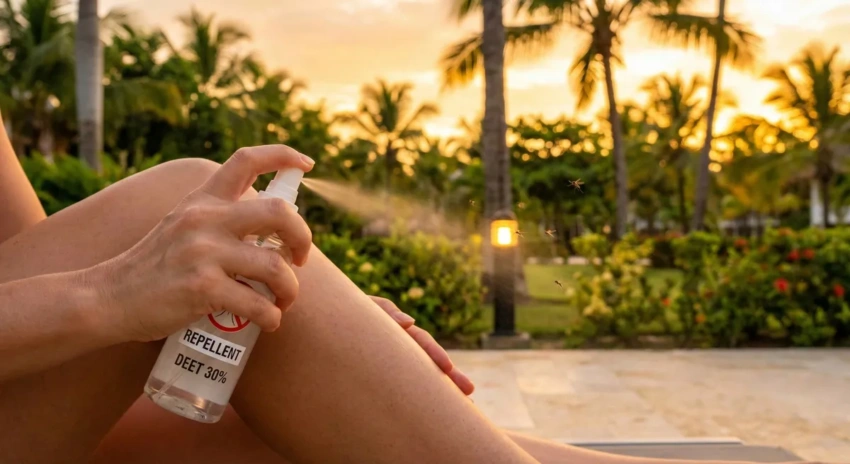
Malaria, Zika and Dengue: how to protect yourself?
Biological fact: they bite during the day!
We’re used to our native mosquitoes flying out to hunt in the evening around a campfire. The tropical Aedes mosquito is a diurnal predator.
- Peak activity: early morning (from dawn to 9:00 AM) and pre-sunset (4:00 PM to 6:00 PM).
- Habitat: they love to live near people – in hotel lobbies, under tables in outdoor restaurants, in dark corners of rooms.
- You MUST apply repellent not only before dinner but also before breakfast.
Dengue fever
- According to the WHO, the number of dengue cases in the Caribbean increases during the rainy season (May to November).
- Among symptoms, there is a sharp rise in temperature to 40°C, severe pain behind the eyes, and aching joints (hence the name).
- There is no specific medication. So, if you have dengue, do not take aspirin or ibuprofen (they thin the blood and can cause bleeding). Only paracetamol.
Zika virus: risk to expectant mothers
For the average adult male, Zika typically causes a mild rash and red eyes for a couple of days. Many don’t even notice they are sick.
- The main danger is that the virus infects the fetus in the early stages of pregnancy.
- According to the CDC recommendations, pregnant women are advised to postpone travel to high-risk areas (including the Dominican Republic). If you are planning to conceive, doctors recommend waiting 2–3 months after returning from vacation.
Defense protocol (chemistry vs nature)
Natural oils are a waste of money. You need the “heavy artillery.” Look at the ingredients and with the word DEET.
- 10% DEET – protection for 1-2 hours (for a walk).
- 30% DEET – protection for 5-6 hours (for a jungle excursion).
- Alternative is Picaridin – it smells less and doesn’t damage plastic (glasses, watches), but is just as effective.
Regarding clothing, we recommend wearing light and loose clothes. Mosquitoes prefer dark and tight-fitting clothing (easier to bite).
4. Food and Water: Survival Rules for the Stomach
Traveler’s diarrhea affects 30% to 50% of tourists to the Caribbean. It’s not because the food is “bad,” but because your gut flora is exposed to new bacteria.
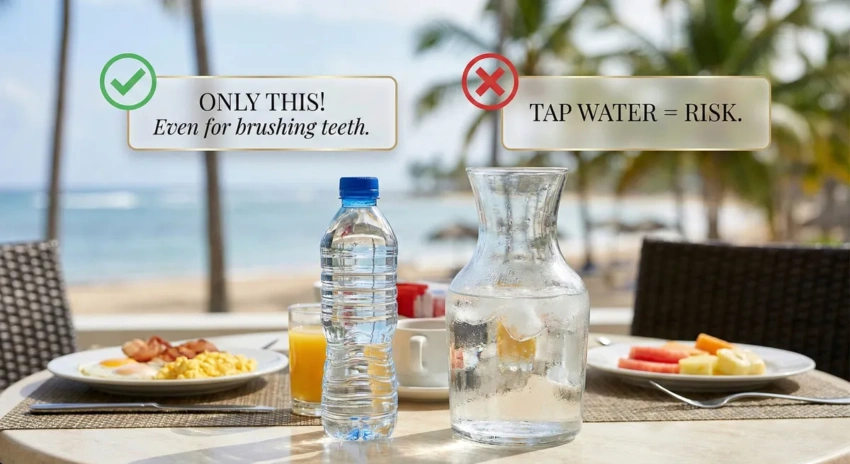
Safety water rules for the Dominican Republic vacation
Water is taboo number 1
In the Dominican Republic, the water purification system IS NOT designed for drinking. The pipes can harbor amoebas and bacteria.
- The ironclad rule is NO tap water. Even for rinsing your mouth when brushing your teeth, use bottled water if you have a weak stomach.
- The ice myth is “Don’t use ice, it’s from the tap!”
- But in reality, in hotels and large bars, ice is brought in from factories (Hielo Industrial). It is made from filtered water and is shaped like a cylinder with a hole in the middle. This ice is safe.
- However, if you see a bartender chopping ice from a huge block with a knife (on a remote beach), avoid that.
Rule: «Boil it, cook it, peel it, or forget it»
Remember this mantra: “Boil, fry, peel – or forget it.”
- Anything that has been heat-treated is safe. A coconut that’s been opened in front of you (the juice inside is sterile). Fruits from which you’ve peeled the thick skin yourself (bananas, pineapples, mangoes).
- At risk are fresh salad greens, tomatoes, unpeeled apples. They may have been washed with tap water.
- The real danger are raw shellfish and ceviche in questionable locations. In hot weather, bacteria in seafood multiply at twice the rate.
5. If You Do Get Sick: Medicine and Prices
Forget the horror stories about “third-world hospitals.” Medical care in Punta Cana’s tourist area is a high-quality, privately owned business. It boasts state-of-the-art equipment, doctors trained in the US or Spain, and impeccable cleanliness. But there’s one catch: it’s very expensive.
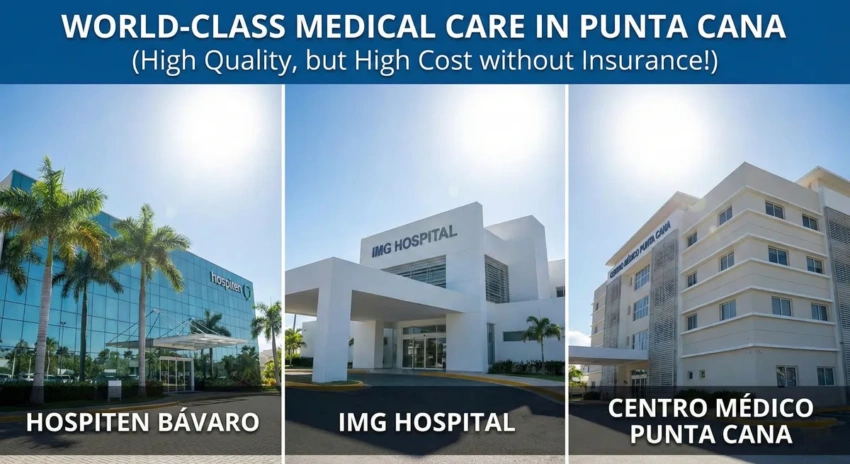
Top 3 of the best hospitals in the Dominican Republic
Where to go (top 3 clinics for tourists)
If something happens, don’t ask the hotel reception for “where’s closest.” Go to trusted places. Punta Cana has three giants that operate to international standards:
- Hospiten Bávaro is the most famous clinic. Part of a Spanish chain. Located in the center of Verona, near the airport. They have everything from an MRI to an intensive care unit. The staff speaks English.
- IMG Hospital is a new, state-of-the-art hospital built specifically for tourists. They have one of the best departments for handling international insurance.
- Centro Médico Punta Cana is the oldest private clinic in the region. Very strong surgical and trauma services.
Financial reality (why insurance is necessary)
Many tourists buy insurance “just to tick the box,” with $30,000 coverage. In the Dominican Republic, this may not be enough. Actual prices (without insurance):
- Doctor’s consultation in the emergency room: $150-200.
- Blood test + IV for dehydration: $300-500.
- One day in the hospital (ward): $1,500-2,500.
- Surgery (e.g., appendicitis): from $10,000.
Even if you have good insurance, reception may ask for a credit card to “freeze” a deposit (usually $500-1000). This is a guarantee in case the insurance company refuses (for example, if it turns out that the injury was sustained while intoxicated – and this is not an insured event for 99% of companies!).
Pharmacies (Farmacia) – lifehack
If the problem is not critical (headache, allergy, mild upset), go to a pharmacy.
- The Dominican Republic has very liberal laws. Antibiotics, strong painkillers, and anti-inflammatory medications are often sold without a prescription.
- Look for signs for Carol or Los Hidalgos (these are large, reliable chains like CVS or Boots). Avoid unmarked stores where medications are stored in the heat.
6. Where to Stay: Safety and Personal Comfort
Health safety goes beyond just vaccinations for the Dominican Republic; it includes your daily environment. All-inclusive hotels are convenient, but they’re always like dormitories: shared pools, shared buffets, and shared air conditioning.

Private accommodation in the DR is the best choice for your peace of mind
If you’re traveling with a large group or family and want maximum control over hygiene (and peace and quiet), consider renting a villa. In Punta Cana, this is often cheaper than renting 3-4 rooms in a good hotel.
Why is a villa a “sanitary suite”?
- Many villas offer the option of a personal chef. This eliminates the hassle of dirty hands or stale salads. Groceries are purchased specifically for you.
- You have your own private pool, which is cleaned for you, not for the crowds of tourists.
- You’ll encounter fewer strangers, dramatically reducing the risk of catching a common cold or flu in the lobby.
Trusted options for accommodation in the DR
If you’re looking for proven locations where comfort and safety are combined, consider these villas in prime areas (Bavaro, Los Corales, Cocotal):
- Villa Waterfall features a private “cocktail pool,” a barbecue area, and, most importantly, maid and chef services are included in the price. Just relax, while pros take care of your daily routine.
- Villa May is a huge, modern 7-bedroom villa directly on the oceanfront in the Los Corales area. A private pool and maid are included. An excellent choice if you want to fall asleep to the sound of the waves, but in complete privacy.
- Golf Villa Cocotal is a quiet, stand-alone home made for people who prefer privacy over a busy resort. It sits along the golf course and opens out to a private pool, garden, and shaded terraces.
- Villa Desiree is a luxury golf villa at Cocotal Golf & Country Club. It has modern architecture, refined style, and true family comfort. It has a private pool, panoramic terrace, and children’s playground; a great choice for families and groups.
-

Luxury All Inclusive Villa Waterfall in Punta Cana (Bávaro, Cocotal) – Private Pool, BBQ, Maid, Chef & Meal Plans
from $1320 / night View Details -

Villa Désirée – Luxury Golf Villa in Punta Cana’s Prestigious Cocotal Golf & Country Club – Huge Private Pool & BBQ Area, Kids’ Playground
from $1099 / night View Details -

Villa May – New Modern Beachfront 7BR Villa with Pool & Maid in Bavaro, Los Corales
from $1200 / night View Details -

Spacious 4-BR Punta Cana Golf Villa in Cocotal – Private Pool, Jacuzzi & Basketball Hoop for Family Fun
from $649 / night View Details -

Villa Agapi (Caleton Estates 57) – The Most Beautiful Ocean View Villa in Cap Cana
from $2850 / night View Details -

Exclusive Ocean View 5-Star Cap Cana Villa for Rent – Chef, Butler, Maid & Golf Cart
from $4600 / night View Details
Final Pre-Departure Checklist
Print this list or save a screenshot. If you check all the boxes, your vacation will be safer than 99% of tourists.
1. At home (2-4 weeks before departure):
- Tetanus/Diphtheria – check that your last vaccination was less than 10 years ago.
- Hepatitis A – have received at least one dose of the vaccine (or have antibodies).
- Insurance – purchase a policy with at least $50,000 coverage (preferably $100,000) and an “Active Recreation” option (if you plan on surfing or ATV riding).
2. In the suitcase (first aid kit):
- Repellent – strictly containing 30% DEET or Picaridin.
- Sunscreen – SPF 50+ cream (the Dominican sun burns white skin in 20 minutes). Panthenol for burns.
- Stomach – sorbents (Enterosgel/Charcoal), Regidron (for dehydration), Loperamide (emergency aid).
- Allergy – antihistamines (Cetrin/Suprastin) – bites from local midges can be very itchy.
3. On-site (rules of conduct):
- Do NOT drink tap water.
- Repel mosquitoes (especially in the morning and before sunset).
- Cook food thoroughly (or wash/clean it yourself).
This country is a paradise. There are no epidemics, plagues, or deadly dangers at every turn, as long as you practice basic hygiene. These precautions and vaccinations aren’t paranoia, but your “seat belt” to fully enjoy the Dominican Republic. Buckle up and enjoy the best vacation of your life!
Frequently asked questions about
vaccinations for the Dominican Republic
What shots do you need to go to Punta Cana?
The Dominican Republic doesn’t require you to show a vaccination certificate at the border. However, doctors strongly advise against flying empty-handed. Your basic kit for peace of mind includes: Hepatitis A (from contaminated water/food) and Typhoid. Also, check when you last had a Tetanus shot – this vaccine needs to be renewed every 10 years.
Do I need jabs to go to the Dominican Republic?
No, you’ll be allowed in without them. Border guards don’t care. This is purely a matter of your personal safety. If you’re flying from the US, Canada, or Europe, you won’t be asked for any “shots” at entry.
The only exception is if you’re transiting from a country experiencing a yellow fever outbreak (such as Brazil), in which case you may be asked for a certificate.
Do I need malaria pills for Punta Cana?
The risk of malaria in Punta Cana is considered very low. The main outbreaks are located on the western border, closer to Haiti. The CDC (U.S. Centers for Disease Control) generally does not recommend taking strong antimalarial medications for tourists traveling to the resort area of La Altagracia Province (Punta Cana). A good repellent will suffice.
Do I need any vaccinations to travel to the Caribbean?
The entire island of Haiti (where the Dominican Republic is located) has a risk of malaria, but it’s unevenly distributed. In tourist areas like Punta Cana, cases are rare. You only need to worry about it if you’re planning jungle treks or traveling toward the Haitian border.
Is Punta Cana a Malaria zone?
Most Caribbean islands have similar risks. Hepatitis A (as water purification standards may vary) and typhoid fever are recommended everywhere.
If you’re planning a multi-island cruise, this kit will provide universal protection everywhere.
How soon before travel to get vaccines?
Your body needs time to develop antibodies. For most vaccines, the optimal time is a month to a month and a half before departure.
Running late? Even if you have two weeks left before your flight, it’s best to get vaccinated now. Partial protection is better than no protection at all.
Is traveler's diarrhea common in the Dominican Republic?
This is the most common problem for tourists in the tropics. The local water and bacteria are unfamiliar to our stomachs. To avoid being among the 30-50% of those affected, follow the rule: “Boil it, fry it, peel it, or don’t eat it.” And drink only bottled water.
What do I need to do before I travel to the Dominican Republic?
- Visit your doctor a month before your trip to discuss vaccinations.
- Get good travel insurance that includes medical evacuation coverage.
- Complete an E-Ticket: This is a mandatory electronic form for entry and exit (can be completed online for free).
- Pack a first aid kit with repellents, bandages, and stomach medication.
Can you travel if you're unvaccinated?
You’ll be allowed into the country without any problems. But remember, you assume all risks. Medical treatment in the Dominican Republic is expensive, and tropical diseases can ruin your entire vacation.
Can I brush my teeth with tap water in Punta Cana?
NO! Don’t risk it. Tap water in the Dominican Republic is not suitable for drinking. Even locals buy bottled water (botellones). To avoid an upset stomach, even use bottled water for brushing your teeth.
Is there a mosquito problem in Punta Cana?
Mosquitoes are present here year-round, but are especially numerous during the rainy season. They carry not only the itch but also the dengue and Zika viruses. Be sure to bring DEET repellent and wear protective clothing at sunset.
What not to do in Punta Cana?
- Don’t drink tap water. Ever.
- Don’t eat raw seafood in questionable places (risk of Hepatitis A).
- Don’t walk alone at night outside of tourist areas.
- Don’t forget sunscreen. The Dominican sun burns your skin in 20 minutes.
- Don’t pet stray animals. They can carry diseases.
Updated on: . Author: